
Non Emergency
Contact Form
How Fast Does Water Damage Get Worse? A 72-Hour Timeline from the Field
A homeowner in metro Detroit had a furnace leak in a
beautifully finished basement. It was not dramatic. There was no flood and no
burst pipe spraying across the room, just water quietly working its way across
the vinyl flooring and into the drywall. Caught in the first day or two, it
would have been a straightforward job: pull the baseboard, dry the drywall in
place, address a little trapped moisture, and clean up the belongings in a
nearby closet. The estimate would have landed somewhere around three to four
thousand dollars.
The homeowner waited about seven weeks.
By the time our technician walked the basement, none of the
affected drywall could be dried in place. It had to be cut out. The flooring
was gone. The baseboard had fungal growth and could not be saved. An entire
closet of stored belongings had become a total loss inventory. The final repair
bill climbed to somewhere between ten and fifteen thousand dollars. Same leak,
same house, three to four times the cost and a far bigger mess, all for one
reason: time.
That is the pattern our crews see over and over, and it is
exactly why we built our water
damage timeline tool. Here is what actually happens to a wet house as the
hours pass, based on what two of our technicians, with more than four decades
in the field between them, told us.
The 72-hour rule
There is a line in every water loss, and it sits at roughly
72 hours.
Inside that window, a clean water loss is largely
recoverable. Past it, three things happen at once. Mold begins to incubate.
Materials that were merely wet start to break down. And, most importantly,
clean water stops being clean. After about three days, water from even a
spotless source has to be treated as Category 3, or black water, which is the
most contaminated classification there is. At that point, anything porous the
water has touched has to come out.
This is why calling early matters so much. It is not about
panic. It is about staying on the right side of that 72-hour line.
Why the type of water matters as much as the clock
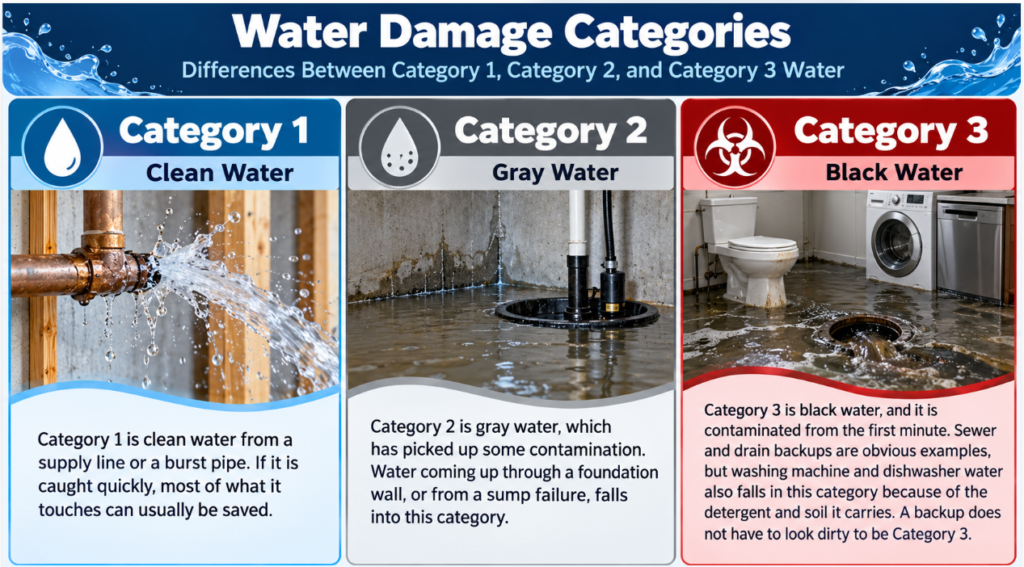
Not all water is equal. Restoration professionals sort it
into three categories.
Category 1 is clean water from a supply line or a
burst pipe. Caught quickly, most of what it touches can be saved.
Category 2 is gray water, which has picked up some
contamination. Water coming up through a foundation wall, or from a sump
failure, falls here.
Category 3 is black water, and it is contaminated
from the first minute. Sewer and drain backups are the obvious example, but so
is washing machine and dishwasher water, because of the detergent and soil it
carries. A backup does not have to look dirty to be Category 3.
Here is the part homeowners miss. With a Category 3 loss,
the clock almost does not matter for porous materials. They come out regardless
of how fast you call. With a clean loss, speed is everything. So the honest
answer to “which is the bigger problem, the water or the time” is
that they work together. The source decides what is at stake. The clock decides
how much of it you can still save.
Two clocks, not one
People assume everything in a wet room is racing the same
deadline. It is not. There are really two clocks.
Porous materials that hold water run on the 72-hour clock.
Carpet, drywall, and soft contents fall here. Carpet padding and wet insulation
are effectively gone the moment they are soaked, because they cannot be dried.
Drywall is sneaky in particular: a water line only four to six inches off the
floor can mean one to two feet of wet wall above it, hidden inside the material
where nobody can see it.
Structural materials run on a much longer clock, closer to
two weeks. Subfloor, plywood, and OSB have real runway. Our technicians rarely
have to replace a subfloor inside 72 hours. When they do replace one, it is
usually because the loss sat for weeks and the boards rotted through, or the
mold grew too thick to clean. Solid framing lasts longest of all. And some
materials, such as ceramic tile and concrete, never go on the clock at all.
Understanding the two clocks is what lets you know, in the
moment, what you can still save and what is already spoken for.
The mistake almost everyone makes
Ask our technicians what homeowners get wrong, and the
answer is immediate and unanimous: they try to handle it themselves. A shop
vacuum and a couple of box fans feel like enough. The surface dries, the panic
passes, and everyone moves on. Weeks later the odor shows up, or staining
appears on the wall, and now there is a mold problem sitting on top of the
original water problem.
The issue is not effort. It is that the damage you can see
is almost never the whole story. Water travels the path of least resistance,
sliding under floors and behind walls to places a shop vacuum will never reach.
By the time the smell arrives, those hidden materials have already been wet for
a long time.
Why this happens so often in Michigan
Michigan homes have their own version of this problem. The
two most common causes our crews respond to are drain backups and sump pump
failures, and the two tend to travel together. A heavy rain overwhelms the
system, the sump cannot keep up or loses power, and the basement takes on
water. Winter adds frozen and burst pipes to the list. And because Michigan is
a humid state, mold spores are always present in the air of every home. A new
water loss does not create mold out of nothing. It feeds what is already there.
Past 72 hours, it is not too late
If you are reading this well past the three-day mark, do not
assume the situation is hopeless, because it is not. The job changes after 72
hours, shifting from drying toward removal and remediation, but there is never
a point where acting stops helping. Left alone, water
damage keeps spreading until something stops it. Every day you wait adds
cost. Every day you act sooner subtracts it. Even at week three, calling is
still the right move.
See your own timeline
The fastest way to understand where your specific situation
sits is to use our water damage timeline tool. Tell it where the water came
from and how long it has been sitting, and it will show you what is likely
still savable, what the clock is doing, and whether you are approaching the
72-hour line.
Water damage timeline
What's still savable, and for how long
Set the two questions below. Where the water came from decides what is at stake; how long it has sat decides how much you can still save. The cost and the risk climb every hour; the materials fall in two waves: porous at 72 hours, the structure weeks later.
Right now this is
Category 1: clean water
The longer it sits ▼
Likely already lost
Savable only if you act now
Still fine if handled promptly
Call before the drying window closes
Most losses don't need a truck at 2 a.m., but the drying has to start before the three-day mark. Call, we'll ask a few questions, and tell you whether we come now or first thing tomorrow.
Guidance only, and deliberately not a price. Every loss is different; only an on-site assessment can determine the actual scope and category of water. Past 72 hours the job changes, but it is never too late to act. The damage spreads until it is stopped.
If you are dealing with water damage right now, you do not
have to figure it out alone. Call us at 248-299-4500.
We will ask a few questions and tell you whether we need to be there today or
first thing tomorrow.